


Which is better for your API: having the server push updates or asking every few minutes?
The decision comes down to latency, traffic volume, and how your network is set up.
Webhooks give near-real-time delivery and cut pointless calls, but need a public HTTPS endpoint, signature checks, retries, and idempotent handling.
Polling is simpler and predictable but wastes requests and adds linear load as you scale.
Thesis: pick webhooks for real-time and low-frequency events, pick polling when webhooks aren’t available or inbound traffic is blocked, and use both as a fallback.
Core Differences Between Push and Pull Models for webhook vs polling

Polling sends repeated requests to an API endpoint on a fixed schedule. Every minute, every 5 minutes, every hour. Doesn’t matter if there’s new data or not. The client starts every check, asking “anything new?” and getting either fresh data or an empty response. Your latency equals your poll interval, so if you’re checking every 5 minutes, worst case you’re waiting 5 minutes for delivery. Webhooks flip it: the server pushes an HTTP POST to your callback the second an event happens, delivering updates in milliseconds to seconds. Think of it as a reverse API where the provider becomes the client.
The efficiency gap? Massive. Polling creates constant traffic even when nothing’s changed, burning bandwidth and API quota. Let’s say you’re polling 1,000 resources every 5 minutes. That’s 200 calls per minute, and most of them return unchanged data. Webhooks cut out the wasted calls entirely by sending payloads only when events fire. You can save hundreds of pointless API requests when activity’s low. Webhooks deliver near real-time updates and lighten server load when events are infrequent, but you’ll need a secure public endpoint, retry logic, and idempotent processing. Polling’s simpler (no public endpoint needed) but adds linear load as you scale clients or tighten intervals.
The webhook vs polling trade-offs come down to four decisions:
- Go with webhooks when you need real-time updates and events don’t fire constantly (payment confirmations, shipping alerts, user activity triggers).
- Stick with polling when the upstream provider doesn’t do webhooks, or when updates are so frequent they’d overwhelm your callback receiver.
- Use polling when firewall rules or network topology won’t allow inbound HTTP traffic to your infrastructure.
- Combine both in a hybrid setup: webhooks for instant delivery, periodic polling as a safety net to catch anything that slipped through.
Understanding Polling Mechanics in webhook vs polling Workflows
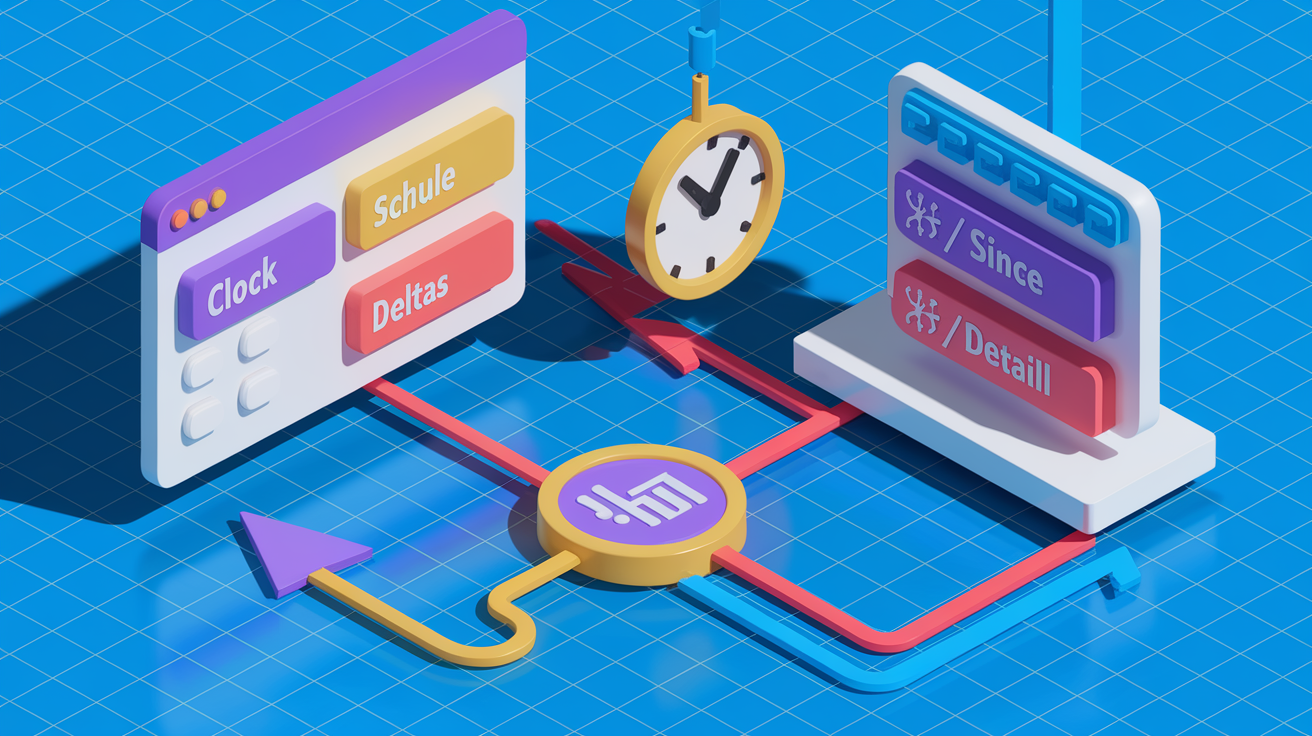
Polling mechanics are simple. Your client sends a GET request to a fixed API endpoint on a timer. Every 30 seconds, every 5 minutes, every hour. The server responds with new or changed records if there are any, or returns an empty set if nothing’s changed since your last query. To track changes, you usually pass a ?since=<timestamp> or ?last_id=<value> parameter so the API only returns deltas. Latency is predictable but locked to your interval. A 5-minute polling cadence means the newest event sits there for up to 5 minutes before your next request finds it.
Resource usage scales linearly with the number of polling clients and how often you’re pinging. The math’s straightforward: requests per minute = clients × (60 / interval_seconds). Polling every 30 seconds gives you 2 requests per minute per client. With 10,000 clients polling every minute, you’re generating 10,000 calls per minute. That volume can slam into provider rate limits, trigger throttling, or rack up costs if the API charges per call. When data changes rarely, most of those requests come back empty. Pure overhead.
Challenges you’ll hit with polling:
- Rate-limit pressure – High-frequency polling across many clients can burn through API quotas or trigger 429 Too Many Requests errors.
- Wasted calls – Repeated requests with no new data eat bandwidth, server CPU, and API credits without giving you anything useful.
- Scalability constraints – Double your clients or halve your interval, and you’ve doubled your request load. Linear cost growth.
- Pagination complexity – Large result sets need multiple round trips, adding latency and making change detection messier.
- Jitter and clock skew – Scheduled tasks can drift or bunch up, creating uneven load spikes if many clients poll at the same moment.
| Polling Interval | Requests per Minute (per client) | Worst-Case Latency |
|---|---|---|
| Every 30 seconds | 2 | 30 seconds |
| Every 5 minutes | 0.2 | 5 minutes |
| Every 1 hour | 0.017 | 1 hour |
How Webhooks Deliver Events in webhook vs polling Comparisons

Webhooks work as a reverse API. When an event fires on the provider’s system (order created, payment completed, status changed), the server immediately sends an HTTP POST to a callback URL you registered. Your application gets a JSON payload describing the event and needs to acknowledge receipt by returning a 200 OK status code. This push model means your client never has to ask “anything new?” because the provider tells you the moment something happens. Latency is near real-time, usually milliseconds to a few seconds, limited only by network transit and your processing time.
Webhook reliability depends on both sides playing their part. If your endpoint’s down or returns a non-2xx response, most providers retry the delivery with exponential backoff. Often 3 to 10 attempts over hours or days. You’ve got to handle duplicate deliveries gracefully by checking an idempotency key or event ID and ignoring replays. Event bursts can crush a single-threaded receiver, so production webhook consumers route payloads into a durable queue and process them asynchronously with worker pools. This splits acknowledgment (fast) from business logic (slower), preventing timeouts and making sure the provider doesn’t retry while you’re still processing.
Security and validation aren’t optional. Webhooks arrive at a public HTTPS endpoint, so you need to verify that each request actually came from the provider and wasn’t messed with in transit. Providers usually include an HMAC signature in a header. You recompute the hash using a shared secret and the raw request body, then compare. Reject any payload with a mismatched or missing signature. Timestamp validation stops replay attacks. Discard requests older than a few minutes. Without these checks, an attacker could spoof events or replay old payloads to trigger actions you didn’t intend.
What you can’t skip with webhooks:
- Retry and backoff handling – Accept that the same event can arrive multiple times. Store event IDs and deduplicate at the application layer.
- Signature verification – Always validate HMAC or JWT signatures using the provider’s public key or shared secret before you trust the payload.
- Queueing and workers – Acknowledge the POST quickly (under 5 seconds) and offload heavy processing to background jobs so you don’t time out and trigger repeated retries.
Side-by-Side Technical Comparison of webhook vs polling Approaches
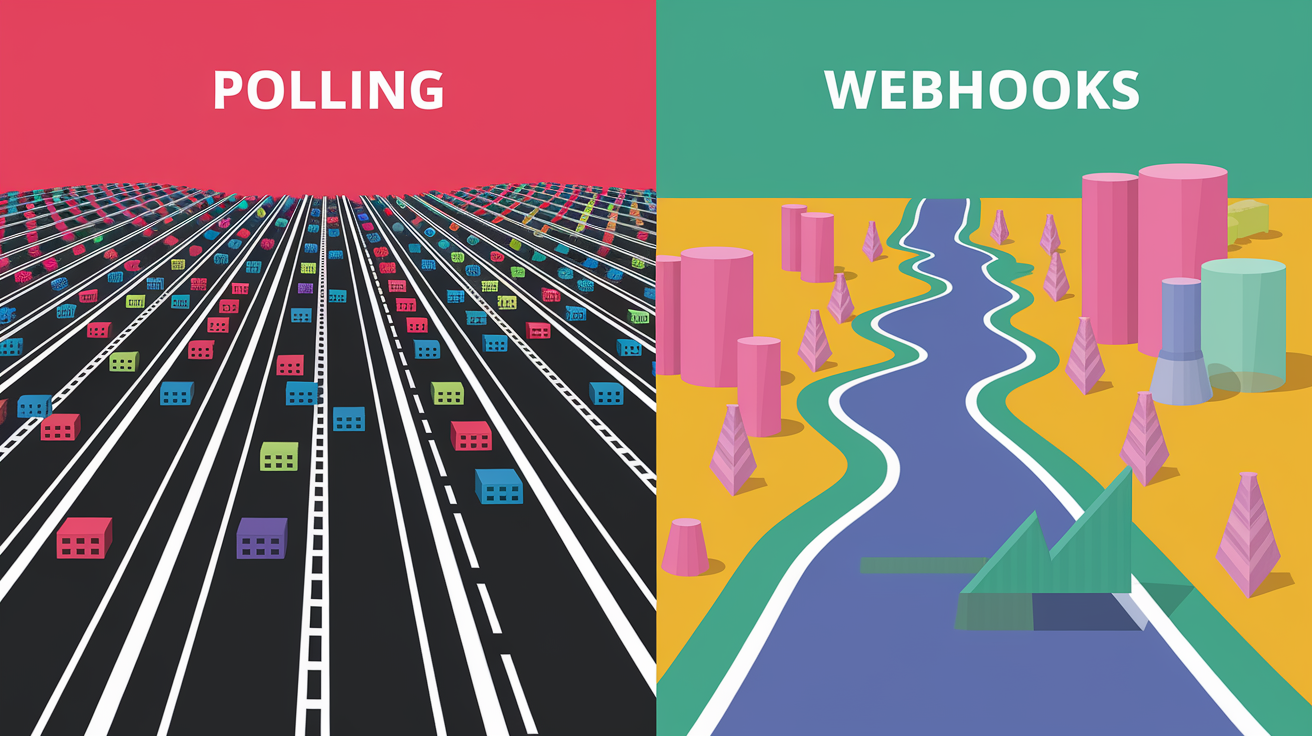
Polling creates predictable, constant traffic whether or not data changes. If you’ve got 1,000 customers and you’re polling every 5 minutes, you’re making 200 API calls per minute. Every minute, all day, no matter what’s happening. Most responses will be empty or unchanged, which means wasted bandwidth and quota. Webhooks reverse the pattern. The provider only sends a request when an event fires, so if nothing happens, you get zero traffic. This cuts out thousands of unnecessary calls when activity’s low, slashing cost and server load. The trade-off is bursty behavior. A sudden spike in events can flood your webhook receiver if you’re not queuing and scaling workers dynamically.
Latency differences are night and day. Polling latency equals your poll interval. With a 5-minute cadence, the newest event waits up to 5 minutes before you discover it. A 1-minute poll cuts that to 60 seconds but doubles your request rate. Webhooks deliver updates almost instantly, typically within a few hundred milliseconds, because the provider pushes the payload the moment the event occurs. Real-time updates are a core webhook strength. Reliability’s more involved, though. Polling is simple and deterministic, but webhooks depend on your endpoint being reachable and the provider’s retry logic being solid. Missed webhook deliveries need fallback reconciliation, often through periodic polling sweeps.
| Metric | Polling Characteristics | Webhook Characteristics |
|---|---|---|
| Latency | Equals poll interval (e.g., 5 minutes) | Near real-time (milliseconds to seconds) |
| Request Volume | Constant, regardless of activity | Event-driven; zero when idle, spikes on bursts |
| Server Load | Steady, scales linearly with clients × frequency | Bursty; receiver must queue and autoscale |
| Implementation Complexity | Simple; no public endpoint required | Requires public HTTPS endpoint, signature validation, retries, idempotency |
| Reliability | Deterministic; you control timing and retries | Depends on provider retries and endpoint availability; can miss events |
| Cost Efficiency | Higher when updates are infrequent (many wasted calls) | Lower when updates are infrequent; pays only per event |
Reliability Patterns and Delivery Guarantees in webhook vs polling Systems

Webhooks can lose events if your receiver’s offline during delivery attempts and the provider’s retry window runs out. Most platforms retry 3 to 10 times with exponential backoff, but if all attempts fail, the event’s either dropped or sent to a dead-letter queue. You need to assume at-least-once delivery. The same event can arrive multiple times because of retries or network hiccups. Idempotent processing is non-negotiable. Store each event’s unique ID in a database and ignore duplicates. Deduplication keeps you from double-charging a customer or creating redundant records when a webhook replays.
Polling gives you deterministic reliability because you control when requests fire and can track the last-seen timestamp or cursor. If a poll fails, you just retry on the next interval. No event is lost as long as the upstream API keeps a queryable change log. The challenge is making sure your polling logic correctly handles pagination, large result sets, and edge cases like clock skew or overlapping time windows. Polling naturally catches missed webhook deliveries if you go hybrid: use webhooks for real-time updates and run a periodic polling sweep (every few minutes or once per day) to reconcile any events that slipped through webhook failures.
Production reliability tools include dead-letter queues for failed webhook deliveries, exponential backoff on retries to avoid hammering a recovering endpoint, and monitoring dashboards that alert when event delivery rates drop or error rates spike. Queue-based processing splits acknowledgment from business logic, letting you return 200 OK quickly while offloading heavy work to background jobs. Timestamps and nonces block replay attacks. Reject any webhook payload older than a few minutes or with a previously seen nonce.
What you need for solid reliability:
- Idempotency keys – Store event IDs and deduplicate before processing to handle at-least-once delivery safely.
- Retry and backoff – Use exponential backoff on webhook consumer errors. Providers do the same on delivery failures.
- Dead-letter queues – Route permanently failed events to a DLQ for manual inspection and replay.
- Timestamp tracking – For polling, persist the last-successful query timestamp to avoid missing or duplicating changes across intervals.
Security Requirements When Comparing webhook vs polling Implementations

Webhooks expose a public HTTPS endpoint to the internet, so every incoming request is untrusted until you verify it. Signature verification is required. The provider calculates an HMAC hash of the raw request body using a shared secret and includes it in a header (usually X-Webhook-Signature or X-Hub-Signature-256). Your receiver recomputes the hash with the same secret and compares. Reject any payload with a missing or mismatched signature. It’s either spoofed or tampered. Timestamp validation adds a second layer. Discard requests older than 5 minutes to stop replay attacks where an attacker intercepts and resends a valid signed payload hours later.
Polling security is simpler because you start every request. Standard API authentication (OAuth tokens, API keys, or JWTs) controls access, and you never expose a public endpoint. The main risks are credential leakage and rate-limit abuse, both fixed by rotating secrets regularly and respecting provider throttle limits. Polling doesn’t face impersonation attacks, but you still need to validate TLS certificates when connecting to the upstream API to prevent man-in-the-middle interception.
What you can’t skip for webhook security:
- HMAC signature verification – Always validate request signatures using the provider’s secret before you trust the payload. Reject unsigned or invalid requests immediately.
- Timestamp and nonce validation – Discard payloads older than a few minutes and track nonces to stop replay attacks.
- TLS enforcement – Require HTTPS for all webhook endpoints. Reject plain HTTP to keep payload confidentiality and integrity in transit.
Scaling webhook vs polling in Large Systems and Real-Time Architectures

Polling scales linearly with the number of clients and poll frequency. If you’re polling 10,000 customers every minute, you’re generating 10,000 requests per minute. Every minute. Double the customer count or halve the interval, and you’ve doubled the load. This predictable growth makes capacity planning simple but expensive at scale. High-frequency polling can burn through API rate limits, trigger throttling, or rack up per-request costs that grow without a ceiling. Connection pooling and horizontal API client scaling help, but the core problem stays the same: most requests return no new data, wasting resources.
Webhooks shift the challenge from outbound polling to inbound event processing. When events are rare, webhooks are ridiculously efficient. Zero traffic when nothing happens. But when events spike (thousands of tickets created in a short window, or a flash sale generating payment events), your receiver faces a burst of concurrent HTTP POSTs. Without queueing, this can overwhelm application servers, exhaust database connections, or trigger cascade failures. Production webhook consumers route payloads into a durable message queue (RabbitMQ, AWS SQS, Google Pub/Sub) and scale worker pools dynamically to process events at a sustainable rate. Autoscaling based on queue depth keeps response times low and prevents dropped deliveries.
Event-driven architectures depend on distributed queues and workers to split ingestion from processing. A small pool of HTTP servers acknowledges webhook POSTs in under a second and writes payloads to a queue. Background workers consume from the queue, do the business logic, and commit results to databases. This pattern isolates slow operations (external API calls, database writes, email sends) from the webhook acknowledgment path, preventing timeouts and retries. Concurrency limits on workers stop resource exhaustion, and dead-letter queues catch poison messages that repeatedly fail.
Real-world infrastructure patterns:
- Message queues and brokers – Use RabbitMQ, Kafka, or cloud-native queues (SQS, Pub/Sub) to buffer webhook payloads and split acknowledgment from processing.
- Autoscaling worker pools – Scale background job workers based on queue depth or event rate to handle bursts without manual intervention.
- Horizontal API client scaling – For polling, distribute clients across multiple machines or containers to spread load and avoid single-point rate-limit bottlenecks.
Choosing Between webhook vs polling for Practical Use Cases

Use webhooks when you need real-time updates and events don’t fire constantly. Payment gateways push payment.succeeded events the moment a transaction clears, letting you instantly update order status and kick off fulfillment. Shipping carriers send shipment.delivered webhooks so customer-facing dashboards reflect current package locations without lag. User activity triggers (new sign-ups, profile changes, subscription cancellations) benefit from immediate delivery because delayed notification hurts user experience. Webhooks win in these scenarios: low event volume, high value per event, and strict latency requirements.
Polling makes sense when the upstream provider doesn’t offer webhooks, when firewall rules block inbound HTTP traffic, or when updates are so frequent that webhook bursts would swamp your receiver. Enterprise ticketing systems often have thousands of open tickets per account. Webhook-driven sync would create a flood of ticket.updated events that could saturate queues and databases. Incremental polling (fetching changes every 5 minutes with a ?since=<timestamp> filter) spreads the load evenly and avoids spikes. Polling also works when you need eventual consistency rather than real-time sync, and when the simplicity of client-initiated requests beats the inefficiency of repeated calls.
A hybrid model gives you the best of both. Configure webhooks for instant delivery of high-priority events and run a periodic polling sweep (every hour or once per day) to catch anything the webhook missed because of downtime or delivery failures. This reconciliation pattern keeps you from losing data while keeping most updates near real-time.
Decision checklist for webhook vs polling:
- Does the provider support webhooks? If no, polling’s your only option. If yes, keep going.
- Do you need sub-minute latency? If yes, choose webhooks. If eventual consistency within 5 to 60 minutes works, polling’s fine.
- Are events frequent or bursty? If thousands of events per minute, polling might distribute load better. If sporadic, webhooks cut waste.
- Can you expose a public HTTPS endpoint? If firewall or NAT rules block inbound traffic, you need polling.
- What’s the cost model? If the provider charges per API call, webhooks can save money when events are rare. If flat-rate or unlimited, polling cost is predictable.
- Do you need guaranteed delivery? Go hybrid. Webhooks for speed, periodic polling for reconciliation, so you don’t miss events.
Final Words
In the action, we showed how polling repeatedly checks on fixed intervals while webhooks push events to a callback, then compared latency, efficiency, load, reliability, security, and scaling.
Tradeoff’s clear: polling is simple and predictable but wastes API calls and adds steady load; webhooks are near-real-time and efficient but need secure endpoints, retries, and queuing. Use webhooks for real-time triggers, polling when callbacks aren’t possible, and hybrid for reconciliation.
Pick what matches your latency and ops constraints, small fixes (shorter poll interval or queuing) can avoid late-night incidents. You’ve got a practical path forward for webhook vs polling. Ship it.
FAQ
Q: What is polling an API?
A: Polling an API is client-initiated recurring checks for updates at fixed intervals (for example every minute). It gives predictable load and latency equal to the poll interval but wastes calls when idle.
Q: What is the purpose of a webhook?
A: The purpose of a webhook is to push event data to a callback URL as soon as events occur, enabling near-real-time updates, fewer unnecessary API calls, and lower average traffic compared with polling.
Q: When to not use webhooks?
A: You should not use webhooks when receivers can’t expose secure public endpoints, when events are extremely high-volume causing burst overload, when the provider lacks webhook support, or when periodic reconciliation is fine.
Q: What is the difference between webhook and poll SCM?
A: The difference between webhook and poll SCM is webhooks push repository events instantly to CI on commits, while poll SCM has the CI server check the repo at intervals, trading immediate feedback for predictable polling load.