


Controversial take: MuleSoft developers are the unsung gatekeepers of modern apps.
They turn legacy databases, cloud services, and third-party APIs into a single, reliable data layer.
If you’re thinking about learning MuleSoft, hiring one, or benchmarking pay, you need clear, practical answers on what makes a strong developer and where they land on the pay scale.
This post cuts through the buzz and shows the exact skills (Anypoint Studio, DataWeave, API design), salary ranges, certification impact, and realistic career steps from junior dev to architect.
Role Overview and Core Purpose of a MuleSoft Developer

A MuleSoft developer builds and maintains API-led connectivity solutions using the MuleSoft Anypoint Platform. Think of them as integration engineers who connect systems that were never meant to talk to each other. Cloud apps, legacy databases, third-party services, internal tools. They make data flow so business processes don’t need manual handoffs.
These developers bridge the gap between what the business wants and what IT infrastructure can deliver. They design APIs that expose data in reusable ways, build integration flows that orchestrate complex workflows, and lock down security and performance across every connection. When you’ve got nearly a thousand separate applications running (which is normal for big companies now), MuleSoft developers create order out of chaos by building a unified integration layer.
The role matters for digital transformation. A company launches a mobile app that needs real-time inventory from an ERP system? MuleSoft developer. Marketing wants to sync customer records between Salesforce and a data warehouse? Same answer. They turn integration from a roadblock into something that actually moves the business forward.
Top 5 things MuleSoft developers do:
- Design and build APIs using RAML or OAS specs, making sure they’re reusable with clear contracts
- Develop integration flows in Anypoint Studio that connect systems, transform data, and handle errors
- Deploy and monitor apps on CloudHub, Runtime Fabric, or on-premises Mule runtimes
- Implement data transformations with DataWeave to map between JSON, XML, CSV, and databases
- Apply API policies for security, rate limiting, and access control through API Manager
Essential Skills and Competencies for MuleSoft Developers

MuleSoft developers need integration knowledge, platform skills, and solid software engineering fundamentals. You have to master the Anypoint Platform ecosystem. API Designer, Anypoint Studio, Exchange, Runtime Manager. How they fit together. You’re not just writing code. You’re orchestrating connections across an entire enterprise.
Data transformation happens every day, so strong DataWeave skills aren’t optional. DataWeave is MuleSoft’s functional language for mapping and reshaping payloads. You’ll convert a SOAP XML response into clean JSON, aggregate records from multiple sources, filter sensitive fields before sending data downstream. API design skills matter just as much. Writing clear RAML or OpenAPI specs, applying RESTful principles, thinking through versioning and backward compatibility.
8 skills that matter for this role:
- Anypoint Platform proficiency — actual hands-on time with Studio, API Manager, Runtime Manager, Exchange, and Monitoring
- DataWeave — writing transforms, lookups, and complex mappings without constantly checking docs
- API design — REST principles, RAML/OAS specs, versioning, documentation
- Integration patterns — API-led connectivity, orchestration, publish-subscribe, event-driven architectures
- Authentication and security — OAuth 2.0, JWT, API policies, token management
- Java basics — understanding object-oriented concepts for custom components and troubleshooting
- Version control and CI/CD — Git workflows, Maven builds, automated deployment pipelines
- Cloud and DevOps awareness — deploying to AWS/Azure/GCP, container basics, monitoring and logging
Key Job Responsibilities of a MuleSoft Developer

Day to day, you’re building new integration flows, debugging existing connections, and working with architects, product managers, and business stakeholders to translate requirements into technical specs. You need to understand both the business outcome and the technical pattern and tooling that’ll get you there.
Most of the work happens in Anypoint Studio. Drag and drop connectors, write DataWeave scripts, configure error handlers, test flows locally before pushing to shared environments. You also spend time in API Manager applying throttling policies, setting up client ID enforcement, and reviewing analytics dashboards to spot performance issues. Documentation is part of the job. Every API you build needs clear usage guides and examples in Exchange so other teams can use it without asking you twenty questions.
Security and governance are baked in. You’ll implement encryption for sensitive data, configure OAuth flows for third-party integrations, and make sure API contracts are versioned correctly so downstream consumers don’t break when you change things. Maintenance never stops: monitoring logs, addressing failed transactions, optimizing slow transforms, and updating connectors as systems evolve.
Typical workflow for a new integration project:
- Gather requirements — meet with stakeholders to map source systems, data fields, frequency, and error handling needs
- Design the API contract — draft RAML specs, define endpoints, request/response schemas, and error codes
- Build and test the flow — develop in Studio, write DataWeave transforms, add connectors, test locally with sample payloads
- Deploy and monitor — push to CloudHub or Runtime Fabric, apply policies in API Manager, set up alerts in Anypoint Monitoring
MuleSoft Certifications and Their Career Impact

MuleSoft certifications prove your platform skills and show employers you’ve passed a proctored assessment of real-world integration scenarios. The entry point is MuleSoft Certified Developer – Level 1 (Mule 4), which tests foundational Anypoint Platform knowledge, DataWeave, error handling, and deployment basics. Passing it proves you can build production-ready integrations without constant supervision.
Level 2 certification goes deeper. Advanced error strategies, performance tuning, complex DataWeave lookups, and batch processing. It’s for developers who’ve shipped multiple projects and want to show senior-level expertise. For architects, the Platform Architect and Integration Architect certifications shift from hands-on coding to system design, scalability, and strategic decisions across large enterprises.
Certified professionals consistently outperform non-certified peers. A 2024 integration report found that certified MuleSoft developers deliver projects about 40% faster and produce roughly 35% fewer production bugs. That means faster time to market for business initiatives and fewer late-night incident calls. Employers notice. Certification often unlocks higher starting salaries, faster promotions, and access to high-visibility projects.
| Certificate | Level | Key Skills Validated |
|---|---|---|
| MuleSoft Certified Developer – Level 1 (Mule 4) | Foundational | Anypoint Studio, DataWeave basics, API Manager, CloudHub deployment, error handling |
| MuleSoft Certified Developer – Level 2 | Advanced | Complex transforms, performance optimization, batch processing, advanced error strategies |
| MuleSoft Certified Platform Architect – Level 1 | Architect | API-led design, scalability, team leadership, governance, strategic integration planning |
Salary Expectations and Market Demand

MuleSoft developers command competitive salaries because integration expertise is scarce and demand keeps climbing. In the U.S., typical pay for mid-level developers ranges from $95,000 to $145,000 annually as of 2026, with senior developers and platform architects often pushing past $150,000 depending on location, company size, and years of experience. Certified professionals earn a premium. Certification can add 10 to 15% to base salary compared to non-certified peers with similar experience.
In India, the average salary sits around ₹5.9 lakh per annum, with a typical range of ₹4.0 lakh to ₹10.5 lakh. Geography matters. Developers in Bangalore, Hyderabad, and Pune tend to earn more than those in smaller cities, and candidates with Level 2 certification or specialized Salesforce integration skills can negotiate toward the higher end.
Market demand is strong and growing. Every company undergoing digital transformation needs integration talent, and MuleSoft’s position inside the Salesforce ecosystem makes it a go-to choice for enterprises. Healthcare, financial services, retail, and telecom are the hottest sectors, driven by regulatory requirements, real-time data needs, and complex legacy modernization projects.
Career Pathways and Growth Opportunities
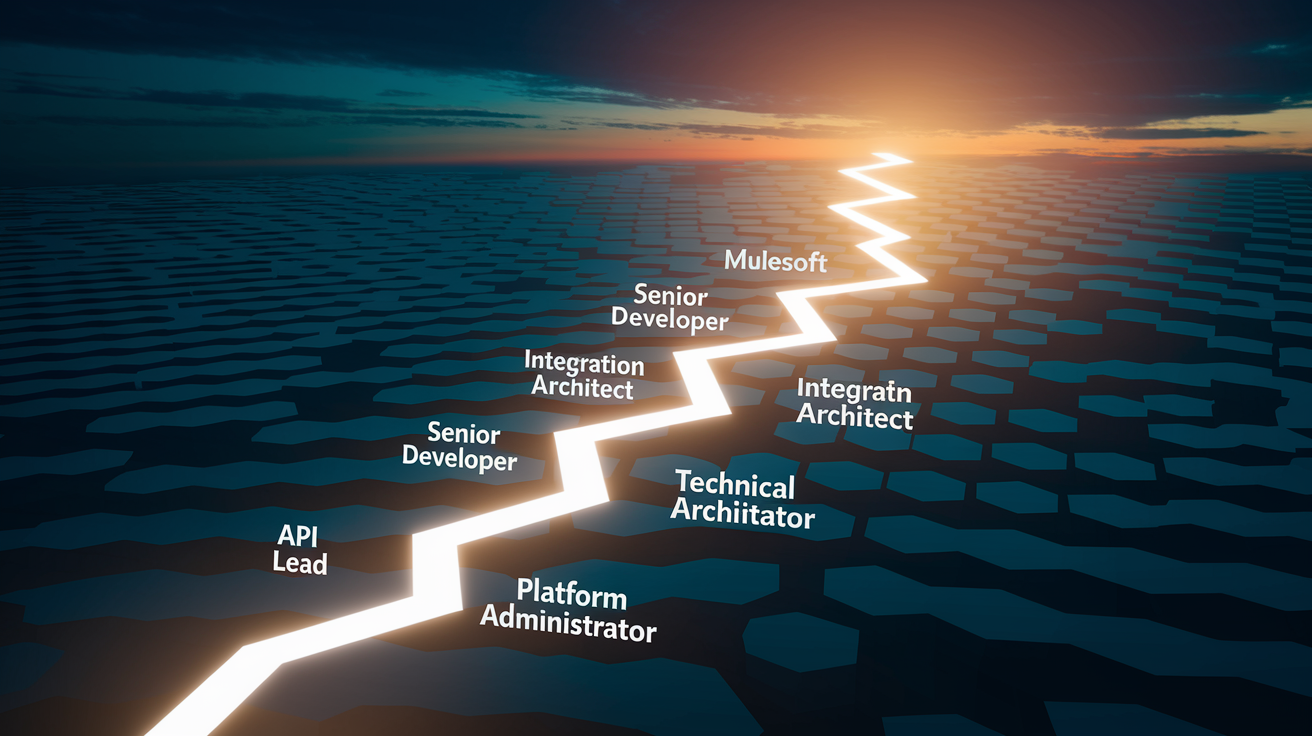
Starting as a MuleSoft developer opens multiple paths depending on whether you lean technical, architectural, or managerial. Many developers progress to senior developer roles within two to three years, taking ownership of larger integration projects, mentoring junior team members, and leading technical design discussions.
From there, a common move is into an Integration Architect or API Architect role. Architects spend less time coding and more time designing system-wide integration strategies, choosing patterns, setting governance standards, and working with enterprise architects and product leadership. These roles need deep platform knowledge plus the ability to translate business goals into scalable technical blueprints.
Another route is specialization. Becoming the go-to expert in a specific domain like Salesforce integration, healthcare data exchange (HL7/FHIR), or financial services messaging (ISO 20022). Specialists can command consulting rates or move into pre-sales engineering roles where they demonstrate MuleSoft capabilities to prospective customers. Some developers shift into platform administration, focusing on Runtime Manager, CloudHub operations, and DevOps automation for large Mule deployments.
5 common career progression routes:
- Senior MuleSoft Developer — lead complex projects, mentor juniors, own delivery timelines
- Integration Architect — design enterprise integration strategies, set governance standards, evaluate tooling
- API Architect — focus on API-led connectivity, reusable design patterns, developer experience
- Technical Lead or Delivery Manager — manage integration teams, coordinate with stakeholders, oversee budgets
- Platform Administrator or DevOps Engineer — maintain Mule runtimes, automate CI/CD, monitor production health
Tools and Platforms Commonly Used by MuleSoft Developers
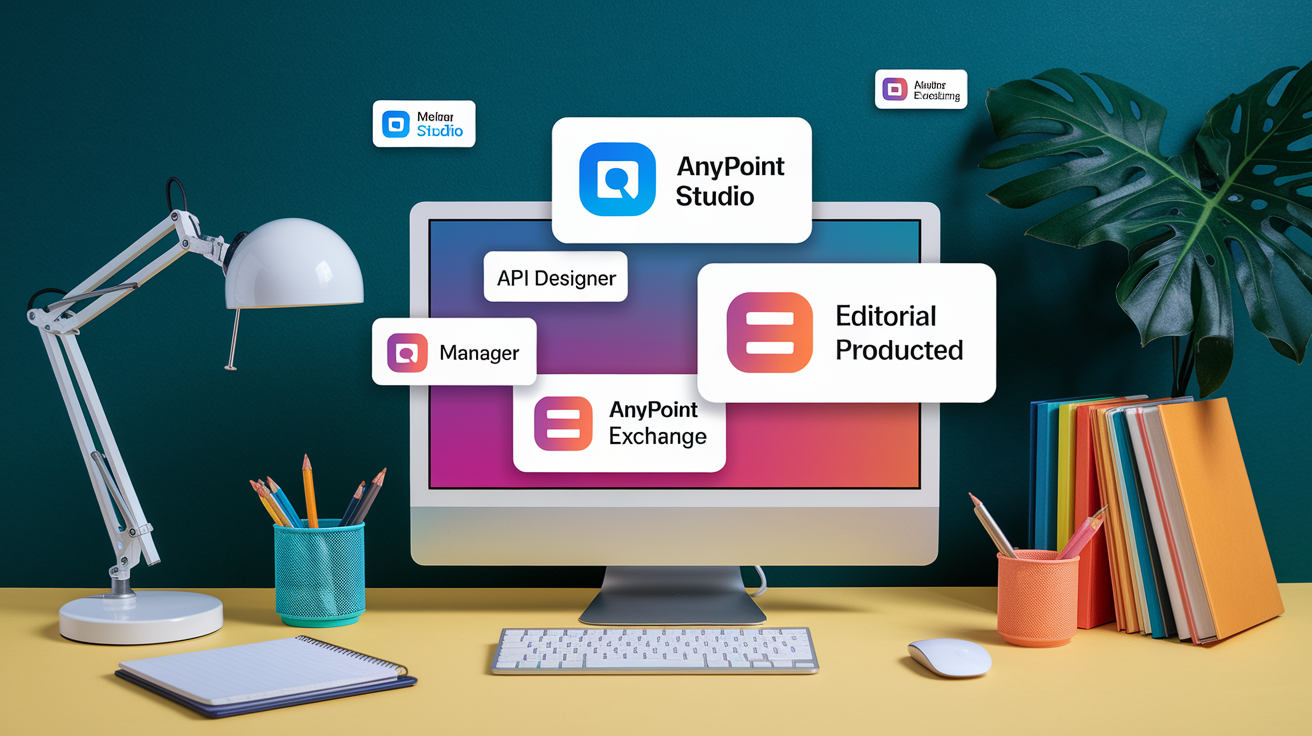
The Anypoint Platform is your daily workspace, and it’s made up of several interconnected tools. Anypoint Studio is the desktop IDE where you build and debug Mule applications. Think of it as the coding environment with a graphical flow designer, embedded Maven, and a local Mule runtime for testing. API Designer is a web-based tool for drafting RAML or OAS specs, letting you define endpoints, schemas, and examples before you write any code.
API Manager is where governance happens. You publish APIs, apply policies (rate limiting, client ID enforcement, OAuth), and monitor usage analytics. Runtime Manager is the deployment console. Whether you’re pushing to CloudHub (MuleSoft’s managed iPaaS), on-premises servers, or Runtime Fabric (containerized hybrid), you control it from here. Exchange is the internal marketplace where teams share connectors, templates, and API specs, making reuse easy across projects. Anypoint Monitoring gives you dashboards for application health, logs, and performance metrics.
6 essential tools in the MuleSoft stack:
- Anypoint Studio — desktop IDE for building, testing, and debugging Mule flows
- API Designer — web tool for writing RAML/OAS specs and mocking APIs
- API Manager — apply policies, manage access, view analytics
- Runtime Manager — deploy and monitor applications across environments
- Anypoint Exchange — discover and share connectors, templates, APIs
- DataWeave Playground — test transforms and mappings in a sandbox before adding them to flows
Common Integration Patterns in MuleSoft Projects

API-led connectivity is the core pattern MuleSoft promotes, organizing integrations into three layers: System APIs (direct access to data sources), Process APIs (orchestration and business logic), and Experience APIs (tailored interfaces for specific consumers like mobile apps or partner portals). This layering promotes reusability. One System API can feed multiple Process APIs, and changes to backend systems don’t ripple through every consumer.
Orchestration patterns combine data from multiple sources into a single response. For example, an order status endpoint might call a CRM API for customer details, an ERP API for inventory, and a shipping API for tracking info, then merge everything into one JSON payload. Publish-subscribe (pub/sub) patterns let you broadcast events. When a new customer registers, you publish an event that multiple downstream systems (email marketing, analytics, billing) can consume independently without tight coupling.
7 integration patterns you’ll use regularly:
- API-led connectivity — System, Process, Experience layers for reusable, modular integrations
- Request-reply — synchronous calls where the client waits for a response
- Fire-and-forget — asynchronous messaging where the caller doesn’t wait for completion
- Publish-subscribe — broadcast events to multiple subscribers via messaging queues or topics
- Aggregation — collect data from multiple sources and combine into a unified response
- Batch processing — handle large volumes of records in chunks with commit/rollback logic
- Content-based routing — direct messages to different endpoints based on payload content or headers
Training Resources and Learning Pathways
MuleSoft offers a structured training catalog with instructor-led courses, self-paced online modules, and hands-on labs hosted on the Anypoint Platform. The official Developer Fundamentals course is the starting point. It covers Anypoint Studio, DataWeave basics, connectors, and deployment. Most people combine this with the free MuleSoft training on Trailhead (Salesforce’s learning platform), which includes interactive tutorials and real-world scenarios.
Hands-on practice is critical. Spin up a free Anypoint Platform trial account, build a few APIs, deploy to CloudHub’s free tier, and experiment with DataWeave transforms using sample JSON and XML files. Work through sample projects like building a REST API that queries a database, creating a SOAP-to-REST bridge, or implementing a batch job that processes CSV files. Real projects teach you error handling, performance tuning, and troubleshooting faster than any slide deck.
Community resources matter too. The MuleSoft forums, GitHub repositories with example projects, and YouTube walkthroughs fill gaps when official docs feel too abstract. Many developers join local MuleSoft meetups or attend the annual CONNECT conference to network and see how other teams solve integration challenges.
4 recommended learning resources:
- MuleSoft Developer Fundamentals (official course) — instructor-led or self-paced, covers core platform concepts
- Trailhead MuleSoft modules — free interactive tutorials with quizzes and hands-on challenges
- Anypoint Platform free trial — build and deploy real projects without spending money
- MuleSoft documentation and API reference — detailed guides, connector docs, and DataWeave function library
Hiring Tips for Employers Seeking MuleSoft Developers

Start by defining exactly which MuleSoft skills you need. Level 1 certification for straightforward integrations, Level 2 for complex orchestration, or architect-level expertise if you’re designing an enterprise-wide integration strategy. Be specific about the systems your candidate will connect (Salesforce, SAP, databases, SaaS apps) and whether you need Salesforce specialization, healthcare HL7 experience, or financial messaging knowledge.
Structure your technical assessment in stages. Begin with a short screening call to verify platform terminology and basic concepts. Ask them to explain the difference between System and Process APIs, or how they’d handle a DataWeave lookup against a large CSV. Follow up with a hands-on task: give them a realistic integration scenario (sync customer records between two systems, transform a complex XML payload) and ask them to build it in Anypoint Studio or pseudocode the flow. Pair programming or live coding sessions reveal how they think through errors, read documentation, and communicate their approach.
5 key evaluation criteria when hiring:
- Hands-on Anypoint Platform experience — verify they’ve built, deployed, and maintained real Mule applications
- DataWeave fluency — test their ability to write transforms, handle edge cases, and optimize performance
- Problem-solving and debugging — present a broken flow or failed integration and ask them to diagnose the issue
- Communication skills — can they explain technical decisions to non-technical stakeholders clearly?
- Cultural fit and collaboration — MuleSoft developers work across teams, so assess teamwork and adaptability
Final Words
You jumped straight into what a MuleSoft developer builds: APIs, integrations, and the flows that link systems. The post walked through core responsibilities, must-have skills, and the Anypoint tools you’ll use day to day.
You also saw certification paths, typical salaries, common integration patterns, learning routes, and hiring tips—so you’ve got both what to learn and what to look for in candidates.
If you’re hiring or aiming to be a mulesoft developer, treat this as a practical checklist. Keep building real projects and you’ll see progress fast.
FAQ
Q: What does a MuleSoft developer do?
A: A MuleSoft developer builds integration solutions with Anypoint Platform, designing, implementing, testing, and managing APIs and flows to connect applications, data, and automate business processes across systems.
Q: Does MuleSoft require coding?
A: MuleSoft development does require coding for complex logic: DataWeave transformations, custom Java components, and script-based error handling, though many integrations use visual flows in Anypoint Studio.
Q: What is the salary of a MuleSoft developer?
A: A MuleSoft developer’s salary typically ranges from $80k to $140k in the US; senior or architect roles often exceed $150k, with variation by location, experience, and certifications.
Q: Is MuleSoft difficult to learn?
A: MuleSoft can be moderate to learn: knowing API concepts, JSON/XML, and basic Java shortens the curve; expect a few weeks for basics and several months to master Anypoint and DataWeave.