


What if one tiny dependency could turn your app into an incident report?
That’s exactly what happens when you skip automated scanning.
Dependency vulnerability scanners crawl manifests, lockfiles, container images, and SBOMs, match versions to CVEs, and alert or block unsafe builds.
They catch transitive issues you’d miss, surface exploitability and remediation steps, and can open automated fix PRs.
If you want fewer late-night pages and safer releases, add a scanner to your CI/CD and run it on every build.
What a Dependency Vulnerability Scanner Does and How It Protects Your Software

A dependency vulnerability scanner automatically spots security flaws in the third-party libraries, frameworks, and packages your software depends on. You’re not manually checking hundreds of dependencies for CVEs anymore. The scanner digs through package manifests, lock files, container images, and Software Bills of Materials (SBOMs), then matches them against public vulnerability databases like the National Vulnerability Database (NVD). And it’s not a one-time thing. When a new CVE drops, you get an alert right away.
Scanners keep CI/CD pipelines secure, stop vulnerable packages from hitting production, and make security checks part of every build. Without automated scanning, you’ll miss vulnerabilities in transitive dependencies (the ones you inherit from packages you install). Remember Log4Shell? Or the 2017 Equifax breach from unpatched open-source components? One overlooked dependency can wreck your entire application.
You should scan continuously or on every build. Quarterly audits leave you exposed. Modern scanners plug into CI/CD to block merges or deployments when high-severity issues show up. They also generate SBOMs, track license compliance, and show you what’s actually running in production containers and infrastructure-as-code resources.
Here’s how detection typically works:
- The scanner pulls your dependency list from package managers (npm, Bundler, Maven, pip, whatever) or parses lock files and container layers.
- It cross-references each package name and version against CVE databases and proprietary threat intelligence feeds.
- Vulnerabilities get enriched with CVSS scores, exploitability data, and remediation guidance.
- Results show up in dashboards, CI/CD logs, or automated pull requests.
- Continuous monitoring watches for new CVEs affecting your current dependencies and alerts you in real time.
Core Features Found in Modern Dependency Vulnerability Scanner Tools

Modern dependency vulnerability scanners share essential capabilities that determine how fast you detect issues, how well you prioritize fixes, and how smoothly security fits into developer workflows. Without these, a scanner’s just a compliance checkbox.
The best scanners combine automated vulnerability alerts with real-time threat feeds, so you’re notified within hours when a new CVE hits your stack. They support continuous integration security (scan on every commit or build, not sporadically). License compliance checking helps you avoid legal trouble from open-source components. False positive reduction cuts down on noise through contextual analysis and policy tuning. Vulnerability prioritization uses CVSS scoring and reachability analysis to tell you which issues actually matter.
Six must-have features:
- Automated detection across multiple ecosystems (npm, Maven, NuGet, pip, Bundler, Go modules, and more)
- Real-time threat intelligence and database synchronization (updates from NVD, vendor advisories, proprietary sources)
- License compliance checking (flags GPL, LGPL, or custom license restrictions that conflict with your policies)
- CI/CD integration with policy gates (blocks builds or pull requests when high-risk vulnerabilities appear)
- Automated remediation guidance or pull-request generation (suggests version upgrades, patches, workarounds)
- Continuous monitoring (watches deployed applications and containers for newly disclosed CVEs)
These features streamline DevSecOps workflows by shifting security checks left and making remediation fast. Instead of a separate security audit weeks after deployment, developers get instant feedback in their PRs and can merge fixes before code reaches staging.
Leading Dependency Vulnerability Scanner Tools and What They Offer
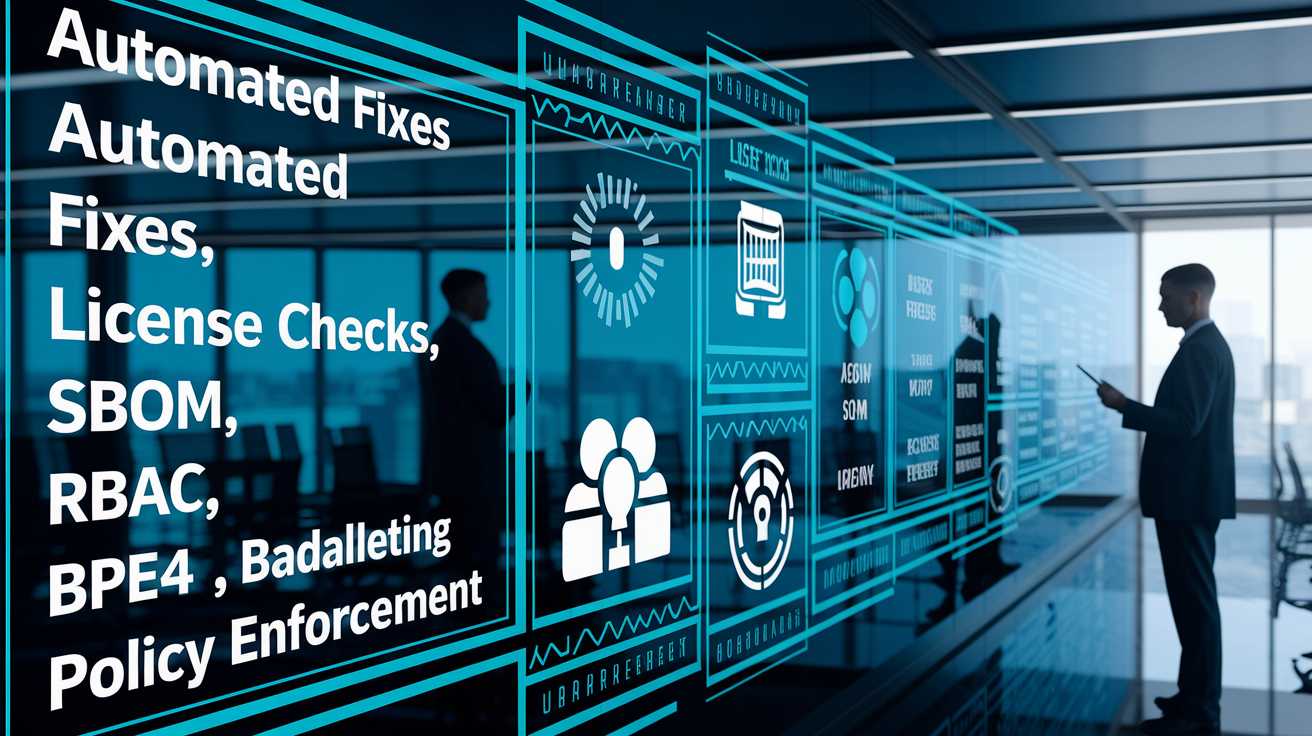
The dependency scanning landscape includes open-source tools for startups and feature-rich commercial platforms for enterprise governance. Each tool has distinct strengths and limits, so your choice depends on team size, tech stack, compliance needs, and budget. Some offer deep developer experience with automated fixes. Others prioritize policy enforcement and audit logs for large organizations.
Open-source scanners like Aqua Trivy and OWASP Dependency-Check give you free, fast CLI-based scans with broad language support, but they lack enterprise features like role-based access control, detailed dashboards, or automated PR workflows. Commercial tools such as Snyk and Mend combine vulnerability detection with license checks, SBOM generation, and pull-request automation. Artifact-centric platforms like JFrog Xray and Sonatype Nexus Lifecycle integrate tightly with build pipelines and artifact repositories, enforcing policies before artifacts are published.
GitHub Dependabot stands out for its native integration with GitHub repositories. It monitors public and private repos, automatically generates update PRs for vulnerable dependencies, and is free for public projects. Checkmarx SCA and Veracode SCA are enterprise-grade platforms that combine dependency scanning with broader AppSec workflows, centralized reporting, and governance features for regulated industries. Anchore focuses on container security, offering policy enforcement, SBOM support, and Kubernetes integration for teams running containerized workloads.
Cloud-native scanners support Docker, Kubernetes, Terraform, and other infrastructure-as-code formats, extending coverage beyond application dependencies to the entire stack. Multi-language support is standard, covering JavaScript, Java, Python, Ruby, Go, .NET, PHP, and more, plus system-level packages from Alpine apk, Debian apt, and Red Hat rpm.
| Tool | Open Source | Key Strength | Ideal For |
|---|---|---|---|
| Snyk | No | Deep OSS vulnerability DB, automated fix PRs, developer-friendly | SMBs and mid-market teams wanting speed and integration |
| GitHub Dependabot | No | Native GitHub integration, automated update PRs, free for public repos | GitHub-centric projects, startups |
| Mend (formerly WhiteSource) | No | Enterprise governance, license management, automated remediation, SBOM | Mid-market and enterprises needing compliance and policy |
| JFrog Xray | No | Artifact-centric scanning, continuous monitoring, build impact analysis | Teams using JFrog Artifactory and artifact-based workflows |
| Sonatype Nexus Lifecycle | No | Mature dependency intelligence, policy-based controls, risk scoring | Enterprises requiring supply-chain governance and accuracy |
| Checkmarx SCA | No | Policy enforcement, license checks, risk prioritization, AppSec integration | AppSec programs at mid-market and enterprise scale |
| Aqua Trivy | Yes | Fast CLI scans, container and IaC scanning, SBOM generation | Solo devs, startups, teams wanting lightweight open-source scanning |
| Anchore | Yes (open-core) | Container-focused, policy enforcement, Kubernetes integration, SBOM | Containerized environments and cloud-native stacks |
| OWASP Dependency-Check | Yes | Free CVE-based scanning, CLI and build tool integration, offline DB | Community projects, budget-constrained teams, local scans |
| Veracode SCA | No | Enterprise AppSec platform, centralized reporting, governance workflows | Large enterprises needing compliance, audit trails, and SOC 2/ISO certs |
Integrating a Dependency Vulnerability Scanner into CI/CD Pipelines

Adding a dependency scanner to your CI/CD pipeline automates security checks so every commit, pull request, or build is verified before it reaches production. The goal? Catch vulnerable dependencies early, fail fast when critical issues appear, and give developers actionable feedback in the same tools they already use. Integration is straightforward. Jenkins, GitLab CI, GitHub Actions, CircleCI, and Azure Pipelines all support plugin or CLI-based scanning.
Container registries and Kubernetes clusters can be scanned using tools like Trivy, Anchore, and JFrog Xray. Artifact repositories such as Nexus and Artifactory integrate directly with Sonatype Nexus Lifecycle and Xray to enforce policies before artifacts are published. Notifications and automated PRs speed up fixes. When a vulnerability is detected, Snyk, Dependabot, or Mend can automatically open a pull request with the recommended version upgrade.
Basic five-step integration flow:
- Add the scanner’s CLI or plugin to your pipeline configuration (GitLab CI job, GitHub Actions workflow, whatever).
- Configure the scanner to read your package manifests, lock files, or container images.
- Set a policy threshold. Decide whether to fail the build on high or critical vulnerabilities, or just log warnings for lower-severity issues.
- Run the scan as part of your build or pre-merge checks, so results appear in logs, dashboards, or PR comments.
- Automate remediation where possible. Accept automated PRs from Snyk or Dependabot, or route findings to a ticketing system for manual triage.
For production-grade pipelines, scan continuously or on every build. Nightly scans miss issues introduced during the day, and weekly audits create exposure windows attackers can exploit. When you scan on every commit, vulnerabilities are caught while the context is fresh and remediation is faster.
How Dependency Vulnerability Scanners Perform SBOM-Based Analysis

Software Bills of Materials (SBOMs) provide a machine-readable inventory of every component in your application, container, or infrastructure stack. Instead of scanning package managers at build time and forgetting what shipped to production, SBOM-based analysis keeps a permanent record of what’s deployed and compares it against continuously updated vulnerability feeds. This makes post-deployment monitoring accurate and traceable, which matters when a new CVE is disclosed weeks after you ship.
Several modern scanners (Mend, JFrog Xray, Anchore, and Trivy) support SBOM generation and analysis using industry standards like CycloneDX and SPDX. SBOM-driven detection improves transparency across your supply chain, helps satisfy regulatory requirements (for example, NTIA minimum elements for software transparency), and enables cross-tool compatibility. You can generate an SBOM with one tool and analyze it with another. SBOM visibility dashboards aggregate findings across multiple projects, teams, and environments, giving security and compliance teams a single pane of glass.
Four standard SBOM-related capabilities:
- CycloneDX and SPDX format generation (export SBOMs in widely accepted JSON or XML formats for sharing with auditors, customers, or downstream tools)
- Automated SBOM creation at build time (integrate generation into CI/CD so every artifact or container image ships with its SBOM)
- Continuous vulnerability monitoring via SBOM comparison (track deployed SBOMs and alert when new CVEs affect listed components)
- SBOM metadata enrichment (include license data, source repositories, and package hashes for full traceability)
SBOMs are increasingly required by procurement contracts, regulatory frameworks, and industry best practices. The U.S. Executive Order on Cybersecurity (2021) and emerging supply-chain security frameworks push organizations to produce and consume SBOMs for critical software. Even if you’re not regulated, maintaining SBOMs simplifies incident response. When the next Log4j-style event happens, you can instantly query which applications are affected instead of scrambling to grep codebases.
Dependency Vulnerability Scanner Remediation Workflows and Best Practices
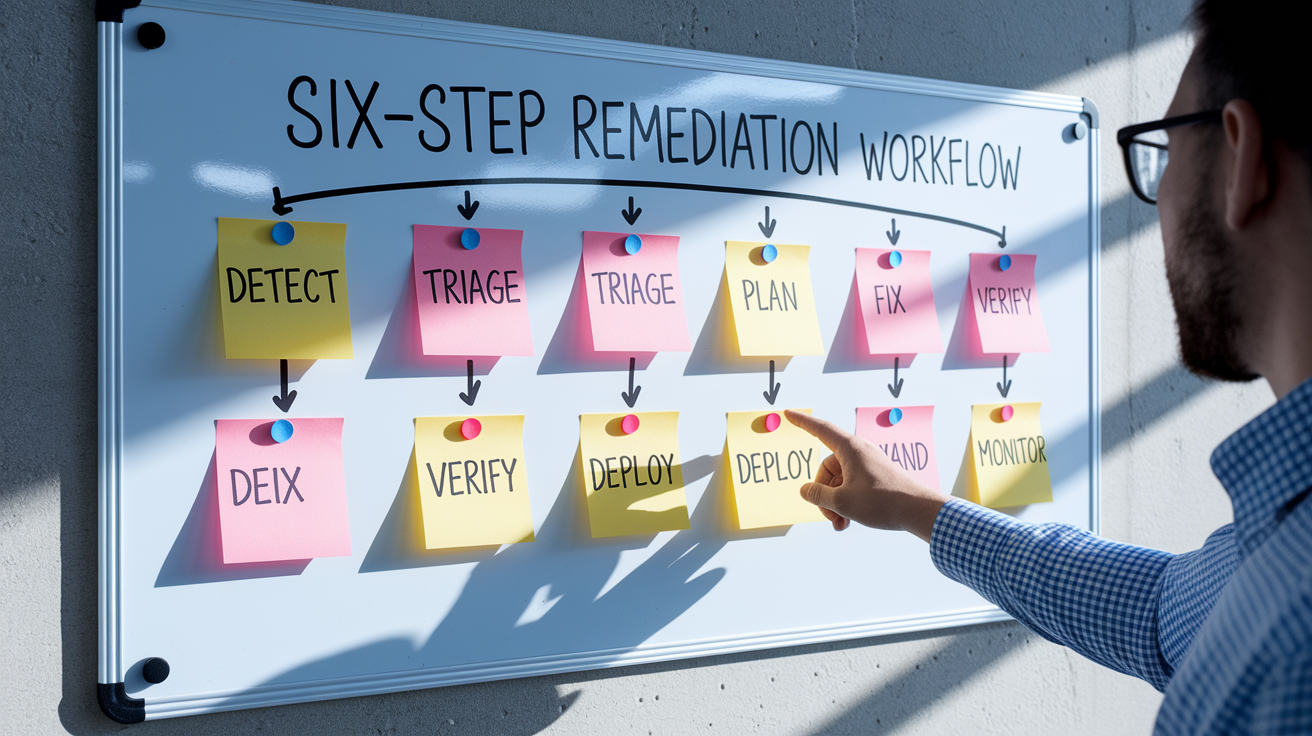
Detecting vulnerabilities is only useful if you fix them quickly. A clear remediation workflow ensures findings don’t pile up as unread alerts and developers know exactly what to do when a scanner flags an issue. The standard sequence balances speed with risk management, prioritizing exploitable issues in production-facing services over low-severity findings in internal tools.
The typical remediation workflow starts with detection. Your scanner flags a vulnerable package and assigns a severity score. Next, you triage by exploitability and exposure. A critical CVE in a public API gets immediate attention. A moderate issue in a dev-only service can wait. Then you plan remediation. Options include upgrading to a patched version, applying a vendor-provided workaround, removing the dependency if it’s unused, or accepting the risk if no fix exists and compensating controls are in place. After planning, you apply fixes (often by accepting automated PRs from Snyk, Dependabot, or Mend, or manually bumping versions). You verify changes by running tests, dependency scans, and container scans on the updated build to confirm the fix didn’t break functionality or introduce new issues. Finally, you redeploy and monitor continuously, watching for regressions or newly disclosed CVEs.
Recommended six-step remediation workflow:
- Detect (automated scan flags the vulnerability and links to the CVE, CVSS score, and remediation guidance)
- Triage (prioritize by severity, public exposure, and whether an exploit is known or actively used in the wild)
- Plan (choose upgrade, patch, mitigate, or accept risk; check if automated PRs are available)
- Fix (apply the update manually or merge the automated PR; remove unused dependencies to reduce future risk)
- Verify (run unit tests, integration tests, and a fresh dependency scan to confirm the issue is resolved and nothing broke)
- Deploy and monitor (release the fix to production and keep continuous monitoring active)
Best practices include removing unused and outdated dependencies to shrink your attack surface, combining dependency scanning with SAST and container scanning for full coverage, shifting security left by scanning early in development and CI, and educating developers on how to select and maintain dependencies responsibly.
Comparing Open-Source vs Commercial Dependency Vulnerability Scanners

Choosing between open-source and commercial scanners comes down to team size, budget, and how much automation you need. Open-source tools like Trivy and OWASP Dependency-Check are free, fast, and transparent. They’re ideal for startups, community projects, and teams with limited budgets. They scan manifests and containers, generate findings, and integrate with build tools via CLI or plugins. The tradeoff? Manual remediation. You get a list of CVEs, but you’re on your own to research fixes, update dependencies, and tune policies to reduce noise.
Commercial tools offer automated fixes, policy enforcement, compliance certifications (SOC 2, ISO 27001, GDPR), and broader language and ecosystem support. They provide role-based access control, audit logs, centralized dashboards, and enterprise-scale support. This matters when you have hundreds of projects, multiple teams, and regulatory requirements. SaaS vulnerability services like Snyk and Mend handle database updates and threat intelligence automatically. On-premise scanner setups (Sonatype, JFrog Xray) let you keep data inside your network for compliance or air-gapped environments.
| Type | Advantages | Limitations | Best For |
|---|---|---|---|
| Open Source | Free, transparent, fast CLI scans, community-driven updates, no vendor lock-in | Manual remediation, higher false positives, limited enterprise features, no automated PRs | Startups, solo developers, community projects, budget-constrained teams, local scans |
| Commercial | Automated fixes and PRs, policy enforcement, compliance certs, RBAC, audit logs, dashboards, broader language support, dedicated support | Higher cost, slower onboarding, potential vendor lock-in, may require enterprise licensing | SMBs, mid-market, enterprises needing compliance, governance, scale, and automation |
Advanced Techniques for Optimizing Dependency Vulnerability Scanner Accuracy

False positives waste developer time and cause alert fatigue. False negatives leave vulnerabilities undetected. Optimizing scanner accuracy requires tuning policies, enriching metadata, and combining signature-based detection with context-aware analysis. False positives often stem from outdated or incomplete vulnerability databases. Scanners may flag a CVE that doesn’t actually affect your usage of the package, or they may misidentify versions. False negatives occur when metadata is insufficient (like when a scanner can’t determine the exact version of a vendored dependency or a compiled binary).
Metadata enrichment approaches (generating SBOMs, including package hashes, tracking source repositories) give scanners more data to work with, reducing misidentification. Policy tuning lets you suppress known false positives, ignore vulnerabilities in dev-only dependencies, or raise the severity threshold for blocking builds. Threat intelligence correlation uses external feeds and exploit databases to prioritize CVEs that are actively exploited in the wild, cutting through the noise of theoretical vulnerabilities.
Three practical tuning techniques:
- Suppress irrelevant findings (configure scanner policies to ignore vulnerabilities in dependencies used only in test or build scripts, or suppress specific CVEs after manual review confirms they don’t apply to your usage)
- Enrich with SBOMs and lock files (use exact version hashes and dependency trees so the scanner can accurately match CVEs, reducing false positives from version range guesses)
- Prioritize by exploitability and reachability (focus on vulnerabilities with known exploits, public PoCs, or that affect code paths your application actually executes)
Future Trends in Dependency Vulnerability Scanning and Supply Chain Security
Dependency scanning is evolving from reactive detection to proactive prevention and predictive analytics. SBOM-driven automation will become the default. Every build, container, and deployment will ship with a machine-readable SBOM, and scanners will continuously compare those SBOMs against real-time threat feeds. AI-based vulnerability prediction will analyze code patterns, dependency graphs, and historical CVE data to forecast which packages are likely to have undisclosed vulnerabilities, enabling teams to avoid risky dependencies before CVEs are published.
Proactive detection of zero-days is emerging through behavioral analysis and anomaly detection in open-source repositories. Supply chain attack prevention frameworks will integrate signature verification, provenance tracking, and policy-based admission controls across build pipelines, artifact repositories, and Kubernetes clusters. Zero trust for dependencies means treating every package as untrusted until it passes signature checks, license validation, and vulnerability scans, even for internal or private packages.
Four future-focused developments:
- SBOM-native pipelines (build systems will generate and validate SBOMs automatically, and vulnerability scanners will treat SBOMs as the primary input for analysis)
- AI-driven risk scoring and remediation suggestions (machine learning models will prioritize fixes based on exploit likelihood, predict which dependencies will be targeted next, and suggest safer alternatives)
- Shift-further-left integration (scanners will run in IDEs, pre-commit hooks, and code review tools, catching issues before code is even committed)
- Automated governance and compliance reporting (platforms will auto-generate audit trails, compliance reports, and risk dashboards that map findings to frameworks like NIST, SOC 2, and ISO standards)
Final Words
in the action we showed how scanners find known issues by parsing manifests, lockfiles, SBOMs and matching CVEs, and why that matters — it helps prevent Log4j-style incidents and keeps vulnerable packages out of production.
We covered core features, leading tools, CI/CD integration, SBOM-driven analysis, remediation workflows, tuning for accuracy, and open-source vs commercial tradeoffs.
Treat a dependency vulnerability scanner as part of your build: run it on every build, automate fixes, and prioritize risk. Do that and you’ll lower exposure and move faster with more confidence.
FAQ
Q: What is a dependency vulnerability scanner and why do I need one?
A: A dependency vulnerability scanner is a tool that finds known security flaws in third-party libraries and packages, preventing vulnerable components from reaching production and reducing risk from incidents like Log4j or Equifax-style breaches.
Q: How do dependency scanners detect vulnerabilities?
A: Dependency scanners detect vulnerabilities by analyzing manifests, lockfiles, containers, or SBOMs, then matching components to CVE databases (NVD and vendors) and applying continuous monitoring to catch newly disclosed issues.
Q: How often should I scan dependencies?
A: You should scan continuously or at every build; continuous scanning or build-time checks catch newly disclosed CVEs early and prevent vulnerable packages from entering CI/CD pipelines or production.
Q: What core features should I expect in a modern scanner?
A: Core features include multi-ecosystem detection, real-time threat feeds, license compliance checks, CI/CD integration, automated remediation (PRs), SBOM support, severity scoring, and prioritization to reduce alert noise.
Q: Which leading tools exist and how do open-source and commercial options differ?
A: Top tools include Snyk, GitHub Dependabot, Mend, JFrog Xray, Sonatype Nexus, Checkmarx SCA, Aqua Trivy, Anchore, OWASP Dependency-Check, and Veracode SCA; open-source tools are free but limited, commercial tools add automation and governance.
Q: How do I integrate a dependency scanner into CI/CD pipelines?
A: To integrate scanning into CI/CD, add the scanner plugin or API call in your pipeline, run scans on build, block builds on high-risk findings, create automated PRs for fixes, and send notifications.
Q: What is SBOM-based analysis and why use it?
A: SBOM-based analysis uses generated SBOMs (CycloneDX or SPDX) to map components and metadata, improving detection accuracy, traceability, and compliance by revealing transitive dependencies and supply-chain exposure.
Q: What remediation workflow should teams follow after a detection?
A: A recommended remediation workflow is detect, triage by severity and exploitability, plan the fix, apply patches or automated PRs, verify changes with tests, redeploy, and monitor for regressions.
Q: How can I reduce false positives and tune scanner accuracy?
A: Reduce false positives by enriching metadata with SBOMs and threat intelligence, tuning severity thresholds and suppression rules, and combining multiple scanners to cross-validate findings and lower alert fatigue.
Q: What future trends are shaping dependency vulnerability scanning?
A: Future trends include SBOM-driven automation, AI-assisted vulnerability prediction, proactive zero-day detection, tighter compliance automation, and stronger integration of threat intelligence into prioritization and governance workflows.