


Trusting environment variables is the silent mistake that hands attackers the keys.
Environment variables are how apps get config, in shells, CI/CD, containers, and runtimes, yet most code treats them as trustworthy system settings.
This post shows how to detect env var tampering (quick checks, CI audits, runtime tracing) and how to stop it with concrete steps: strict validation, minimizing inherited environments, proper secret handling, and isolation of build agents.
You’ll get practical checks and gotchas you can run in minutes.
Core Understanding of Environment Variable Injection

Environment variable injection is a vulnerability where attackers manipulate the environment variables an application inherits or processes, changing how it behaves. Since environment variables are the standard way to pass configuration to programs (shells, interpreters, CI/CD pipelines, cloud platforms), they’re a big attack surface when apps trust what’s in them without checking.
The attack works like this: when an app reads an environment variable to figure out a file path, library location, credential source, or execution mode, an attacker who controls that variable can redirect the app to malicious values. This can happen during process creation, through exported shell variables, via config files that populate the environment, or by injecting values into container runtimes and serverless contexts. The real problem? Most programs assume environment variables are trustworthy system config, not attacker-controlled input.
This matters because it crosses language and platform boundaries. A Python script reading os.environ, a Go binary checking os.Getenv, a Java app resolving system properties, a Bash script expanding $VARIABLE, and a Node.js service using process.env all depend on the same underlying process environment. When that environment gets influenced by untrusted sources (user input, network data, shared hosting, improperly scoped CI/CD secrets), the damage ranges from config tampering to privilege escalation.
Common attack surfaces:
- Shell scripts and command-line tools that expand variables without sanitization
- CI/CD pipelines where build steps inherit job-level or repo-level variables
- Containerized apps that mount host environment values or secrets as env vars
- Language runtimes and interpreters that resolve library paths or feature flags from the environment
How Environment Variable Injection Works at a Technical Level
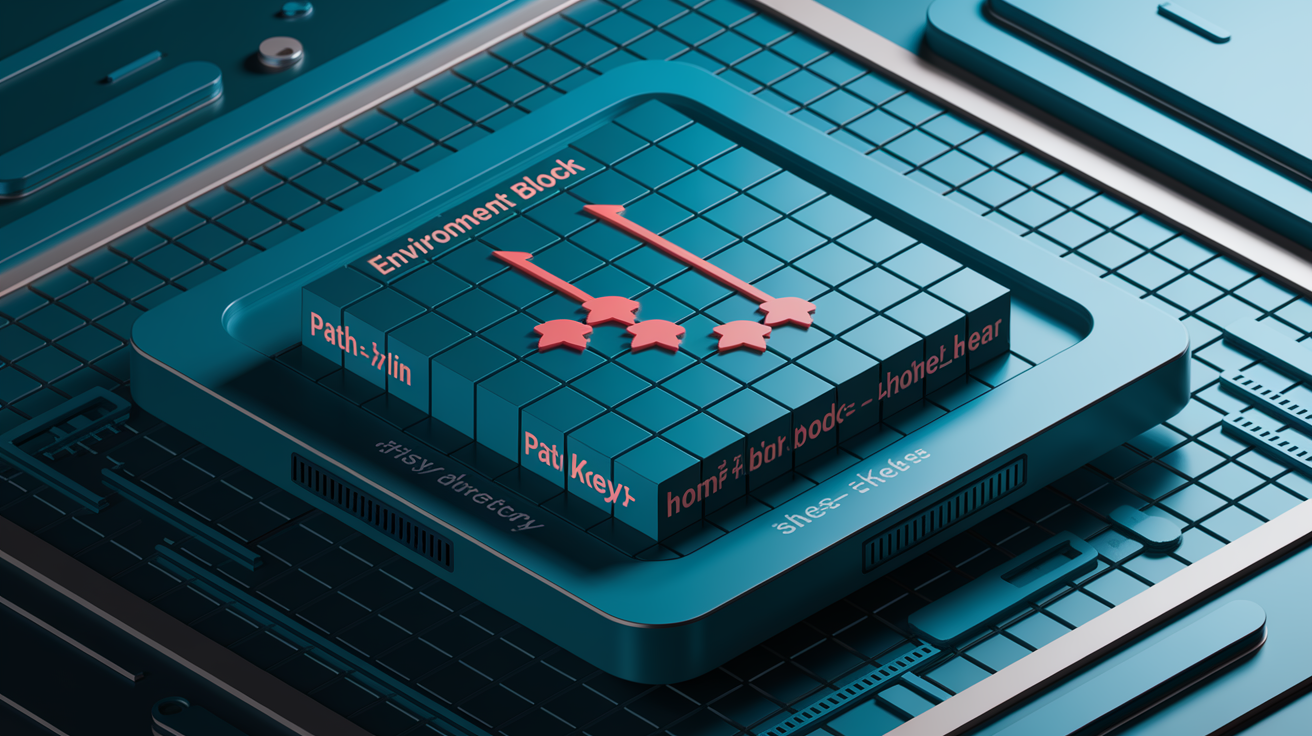
Processes on Unix-like and Windows systems inherit an environment block from their parent at creation time. This block is a collection of key-value pairs the operating system passes down the process tree. When a parent process spawns a child, the child gets a copy of the parent’s environment unless explicitly modified. Apps read these variables at runtime to configure behavior, locate resources, or select execution modes. Most languages provide simple APIs to query environment state (Python’s os.environ, C’s getenv(), shell parameter expansion).
The vulnerability shows up when an application treats environment variable contents as safe configuration instead of external input. If a program builds a file path by combining a base directory stored in an environment variable with a user-supplied filename, an attacker who can set that variable can redirect the program to read or write files somewhere unintended. If a library search path or dynamic loader configuration depends on environment values, an attacker might inject malicious code by pointing the variable to a directory they control. The process can’t tell “system” variables from “attacker-controlled” variables on its own. The risk depends entirely on how the app handles and validates what it retrieves.
Common Components Affected
Shells are the most visible consumers of environment variables. Bash, Zsh, and other Unix shells expand variables inline during command execution. Historical vulnerabilities like Shellshock showed how function definitions exported via environment could be abused to execute arbitrary code. Beyond shells, build systems and task runners (Make, Gradle, npm scripts) often accept configuration through the environment, making CI/CD pipelines a frequent target when untrusted repos or external contributors can influence variable definitions.
Language runtimes themselves may change behavior based on environment flags. Python’s PYTHONPATH changes module search order, Java’s CLASSPATH controls class loading, and Go’s GODEBUG or CGO_ENABLED can modify compiler and runtime behavior. Container orchestration platforms and serverless frameworks expose environment variables as the primary configuration mechanism. When those values come from secrets management systems or user-provided config maps without validation, injection risks multiply.
Development tools and IDEs also store command history and runtime state in environment-derived paths, creating persistence and credential leakage vectors when those paths are attacker-influenced.
Non-Actionable Illustrative Scenarios of Environment Variable Injection

Organizations often encounter environment variable injection risks through routine operational practices that seem safe at first glance. A development team might store database connection strings or API tokens in environment variables for convenience, trusting that container runtimes or orchestration platforms will protect those values. But when a developer runs a diagnostic command that logs the full process environment, or when an application crash dumps all variables into a CloudWatch stream, those credentials become visible to anyone with log access. The risk isn’t in the storage mechanism itself. It’s in the assumption that environment variables remain isolated and protected once set.
CI/CD pipelines introduce another common exposure pattern. A pipeline may accept job parameters or repository-defined variables that are automatically exported into the build environment. If a malicious contributor or compromised repository can inject a variable that overrides a tool’s behavior (changing a code-signing certificate path or redirecting a package manager’s download URL), the build process may incorporate untrusted code without raising alarms. The problem gets worse when build agents are shared across projects or tenants, because one job’s environment can leak into another if proper isolation isn’t enforced.
Container and serverless environments present unique challenges because the boundary between host and workload is porous. A container’s environment is visible to any process on the host with sufficient privilege. In shared-hosting or multi-tenant scenarios, a compromised host or nosy administrator can trivially enumerate running container processes and extract their environment blocks. Serverless functions often inherit platform-managed variables alongside user-defined configuration, and developers may not realize that verbose logging modes or debug flags can cause the runtime to emit full environment snapshots into centralized logs.
High-level scenario categories where environment variable injection risks emerge:
- Shared CI/CD runners where jobs accept externally defined variables without validation
- Development environments where command history or crash dumps inadvertently log secrets passed as env vars
- Containerized deployments where host-level users can inspect process environments
- Web application frameworks that use environment variables to toggle debug modes or admin features
- Third-party libraries and SDKs that read sensitive configuration from the environment without explicit opt-in
Impact of Environment Variable Injection on Systems

The consequences of environment variable injection depend on which variables get manipulated and how the application uses them. At the lowest severity, an attacker might alter non-critical configuration values (changing a log level or a display language) without affecting security. More serious impacts occur when environment variables control security boundaries or execution paths.
When variables influence file or library paths, attackers can redirect applications to load malicious code. Overriding a library search path can cause a legitimate process to dynamically load an attacker-supplied shared object or DLL, granting the attacker code execution within the target process’s privilege context. If the affected process runs with elevated permissions (a setuid binary, a system daemon, or an auto-elevated Windows executable), the attacker effectively escalates privilege without exploiting a memory corruption bug.
Authentication and authorization flows are also at risk when apps derive credential paths, API endpoint URLs, or feature toggles from environment variables. An attacker who can set a variable that points to a malicious credential file or redirects API calls to a hostile server can bypass intended access controls, exfiltrate data, or masquerade as legitimate services. In container and cloud environments, misconfigured variable injection can expose AWS keys, database passwords, or service account tokens to unauthorized users or logs, enabling downstream attacks against backend infrastructure.
The combination of configuration tampering and credential leakage makes environment variable injection a versatile and often underestimated threat vector.
Defensive Strategies and Mitigation Practices

Preventing environment variable injection starts with treating environment variables as untrusted external input rather than secure configuration. Applications should validate variable contents before use, applying strict type checks, format constraints, and allowlisting where possible. If an app expects a boolean flag from the environment, it should explicitly check for known valid values and reject anything else rather than relying on loose truthiness checks that an attacker might exploit with unexpected inputs.
Minimizing the scope of inherited environments reduces exposure. Rather than spawning child processes with a full copy of the parent’s environment, apps should construct a clean environment block containing only the variables the child requires. This principle is especially important in privilege transitions. When a high-privilege process spawns a lower-privilege helper, it should strip out sensitive or control variables to prevent the child from misusing them. On Unix-like systems, this might involve explicitly setting PATH, LD_LIBRARY_PATH, and other loader-related variables to safe defaults. On Windows, clearing or overriding SystemRoot and similar expansion paths prevents redirection attacks.
Runtime hardening should include privilege separation and least-privilege execution. Services that must handle untrusted input or environment-derived configuration should run with minimal permissions, in isolated namespaces or containers, and without access to host-level process inspection. Secrets management systems (HashiCorp Vault, AWS Secrets Manager, Kubernetes secrets) should replace plaintext environment variables for sensitive data, and those systems should inject secrets into the application through secure channels such as mounted volumes or API retrieval rather than process environment blocks. When environment variables are unavoidable, they should be logged and audited, and monitoring should detect unexpected changes to critical variables.
Six mitigation practices:
- Validate and sanitize all environment variable contents before use. Never trust values blindly.
- Construct explicit, minimal environment blocks for spawned child processes rather than inheriting the full parent environment.
- Use dedicated secrets management and secure injection mechanisms instead of plaintext environment variables for credentials.
- Apply privilege separation so that processes handling environment-derived config run with least privilege and in isolated contexts.
- Audit and monitor environment variable changes in production systems and alert on modifications to security-critical variables.
- Educate development and operations teams that sample code using env vars for quick tests must be replaced with secure configuration before production deployment.
Final Words
In practice, we walked through what environment variable injection is, the technical mechanics behind process environments, and the components that usually get affected.
We ran through conceptual scenarios like CI/CD, containers, and wrapper scripts, and reviewed impacts such as altered runtime behavior and credential misuse. Then we covered practical defenses: whitelist variables, validate types, minimize inherited environments, and harden runtimes.
Keep consistent, simple checks. With those defenses in place, environment variable injection attacks become much harder and your systems stay safer.
FAQ
Q: What is an example of an injection attack?
A: An example of an injection attack is SQL injection, where attacker-supplied input alters a database query to read, modify, or delete data, often bypassing intended access controls.
Q: Is SQL injection a layer 7 attack? Which of the following types of attacks is an injection attack?
A: SQL injection is a layer 7 (application-layer) attack; injection attacks generally target application inputs (queries, commands, templates) to alter program behavior, so they’re classified as application-layer exploits.
Q: What are the problems that can be caused by injection attacks?
A: Injection attacks can cause data leaks, unauthorized access, data corruption or deletion, remote code execution, privilege escalation, and configuration tampering, leading to breaches, outages, and loss of integrity.