


What if you couldn’t answer “what’s inside our code” when a zero-day hits?
That exact blind spot is why a Software Bill of Materials (SBOM) matters.
An SBOM is a machine-readable ingredient list of every component, library, version, license, and origin inside your builds.
It turns unknowns into queries you can run in seconds.
Put simply: an SBOM is your security transparency foundation — it speeds CVE triage, proves license and supply-chain provenance, and stops late-night scramble sessions that cost time and risk.
Understanding the Software Bill of Materials and Its Core Purpose

An SBOM is a machine-readable inventory listing every component, library, and dependency inside your software. It’s basically a complete ingredient list for your codebase. Not just the packages you installed on purpose, but the nested dependencies they dragged along, their versions, licenses, known vulnerabilities, and where they came from.
The manufacturing analogy holds up. When a car manufacturer discovers a faulty brake line, they don’t walk the lot inspecting vehicles one by one. They check the BOM, find every model that used that supplier’s part, and issue a targeted recall. An SBOM does the same thing. When something like Log4j breaks, you query your SBOM and know in seconds whether you’re exposed. No scrambling through repos for days.
This isn’t theoretical. Real breaches prove the point. Equifax in 2017 happened partly because the team didn’t have a clear asset inventory. They couldn’t identify which systems ran the vulnerable Apache Struts version. Codecov and Kaseya showed how supply-chain attacks move fast. The 2024 OSSRA report found that 96% of audited codebases contained open source components, 81% had at least one known vulnerability, and over 53% had license conflicts (often GPL clashes).
A complete SBOM typically includes:
- Component identifiers (names and package URLs/PURLs)
- Version numbers for every library and dependency
- License information (MIT, Apache, GPL variants)
- Transitive dependencies (the dependencies of your dependencies)
- Known vulnerabilities with CVE references and patch status
Modern applications don’t have dozens of dependencies. They have thousands. A typical cloud-native container image can include hundreds or even thousands of components from multiple suppliers and open source projects. Trying to track that manually? Impossible. Automation isn’t optional anymore. It’s the only way to keep an accurate, up-to-date inventory that teams can trust when a zero-day is announced or an audit request lands.
Key Components Inside a Software Bill of Materials

SBOMs need to capture more than a simple list of package names. Each entry should include the supplier or origin, the exact version, unique identifiers like a Package URL (PURL), and cryptographic hashes or checksums to verify integrity. Without these details, you can’t confidently determine whether a component matches a published CVE or whether the artifact you deployed is the same one that was scanned.
Dependency relationships matter as much as the components themselves. Your direct dependencies are obvious. But transitive dependencies (the libraries your libraries require) are where hidden risk lives. A vulnerability three layers deep still affects your app. That’s why SBOMs should map the full dependency graph or, at minimum, explain where and why they don’t.
The NTIA (National Telecommunications and Information Administration) defined minimum elements across three categories:
- Data fields: component name, supplier, version, unique identifier, dependency relationships, and component hash.
- Automation support: SBOM must be machine-readable and capable of automatic generation, supporting formats like JSON, XML, or tag-value serializations.
- Practices and processes: generate/update on every component change or release, provide depth (full transitive dependencies or a clear explanation), deliver SBOMs quickly and make them accessible, handle errors with fix commitments, specify access terms and integration allowances.
- Build provenance: include metadata about when and where the SBOM was generated, who created it, and which tool or process was used.
- Patch and vulnerability status: track whether components have known CVEs and whether patches are available or applied.
- License compliance metadata: document governing licenses and flag copyleft or restricted licenses that may create legal or IP risk.
These fields turn an SBOM into an operational asset. Security teams query it during vulnerability triage to identify exposure. Legal reviews it for license compliance. DevOps uses it to track component freshness and spot unmaintained libraries. When a new CVE is published, you cross-reference your SBOM against vulnerability databases and know immediately which builds and deployments are affected. No guesswork, no late-night grep sessions across fifty repositories.
Standard SBOM Formats: SPDX, CycloneDX, and More
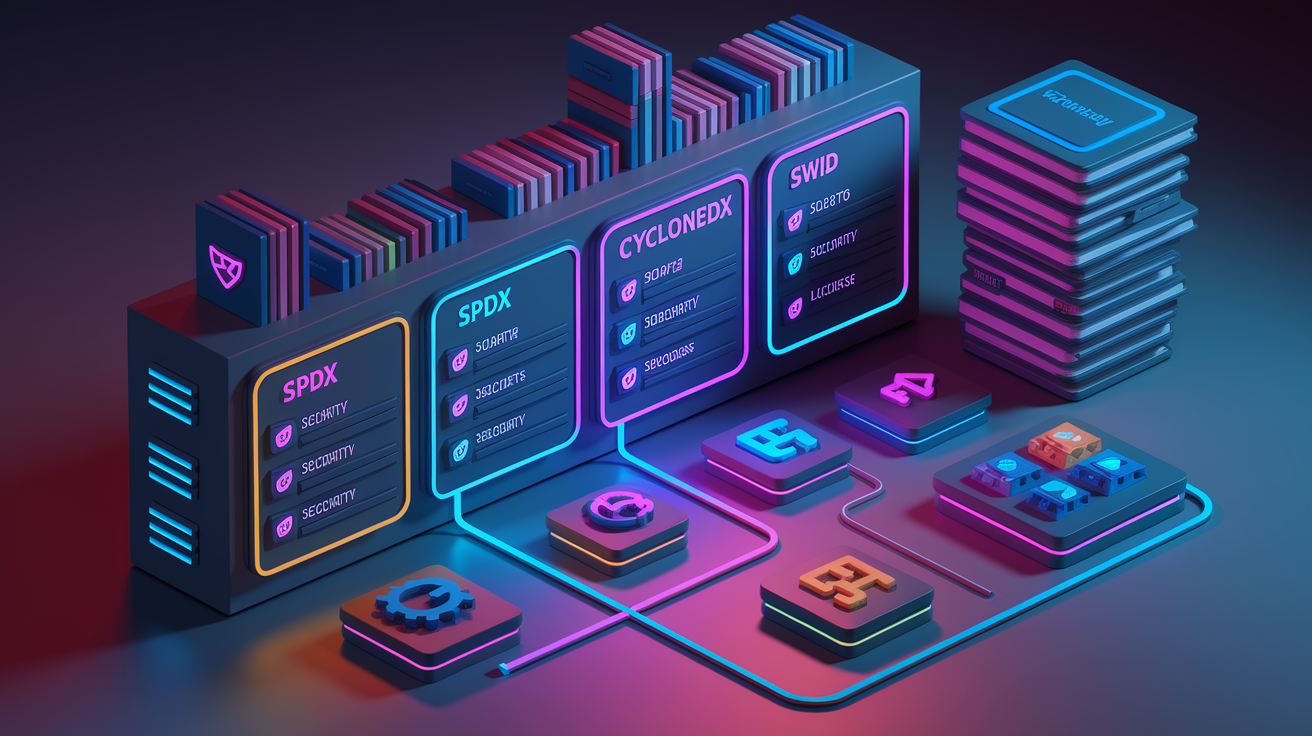
Standardized formats let SBOMs move across tools, pipelines, and organizations without custom parsing. If every vendor invents their own schema, automation breaks. That’s why industry coalitions and regulatory bodies pushed for common specifications that machines and humans can both understand.
SPDX Format
SPDX (Software Package Data Exchange) is the primary format backed by the Linux Foundation. It was originally designed to track open source license compliance but evolved to include security references, copyright details, and cryptographic checksums. SPDX supports JSON, XML, YAML, and a tag-value text encoding. Because it’s mature and widely adopted, many SCA (Software Composition Analysis) tools default to SPDX output. If you’re working with Linux-based systems, containerized workloads, or enterprise open source stacks, SPDX is a safe baseline.
CycloneDX Format
CycloneDX is a lightweight SBOM standard from OWASP that covers applications, libraries, containers, firmware, operating systems, and device drivers. It’s designed to be fast and specific to security use cases, tagging components with vulnerability references, licenses, and dependency graphs in a compact structure. CycloneDX is popular in DevSecOps pipelines where speed and continuous scanning matter. It encodes to JSON or XML and integrates cleanly with CI/CD and container registries.
SWID and Legacy Formats
SWID (Software Identification) tags are an older XML-based standard developed by the ISO/IEC. SWID was widely used by U.S. federal agencies before SPDX and CycloneDX gained traction. It includes installation bundles, patch metadata, and license data, but adoption has declined as newer formats offer better automation support and richer dependency graphs. SWID still appears in legacy enterprise environments and some hardware/firmware contexts.
| Format | Primary Use Case | Encoding |
|---|---|---|
| SPDX | License compliance, open source tracking, enterprise software inventory | JSON, XML, YAML, tag-value |
| CycloneDX | Security-focused DevSecOps, container scanning, vulnerability tracking | JSON, XML |
| SWID | Legacy federal compliance, firmware and OS metadata | XML |
Benefits of a Software Bill of Materials for Security and Operations
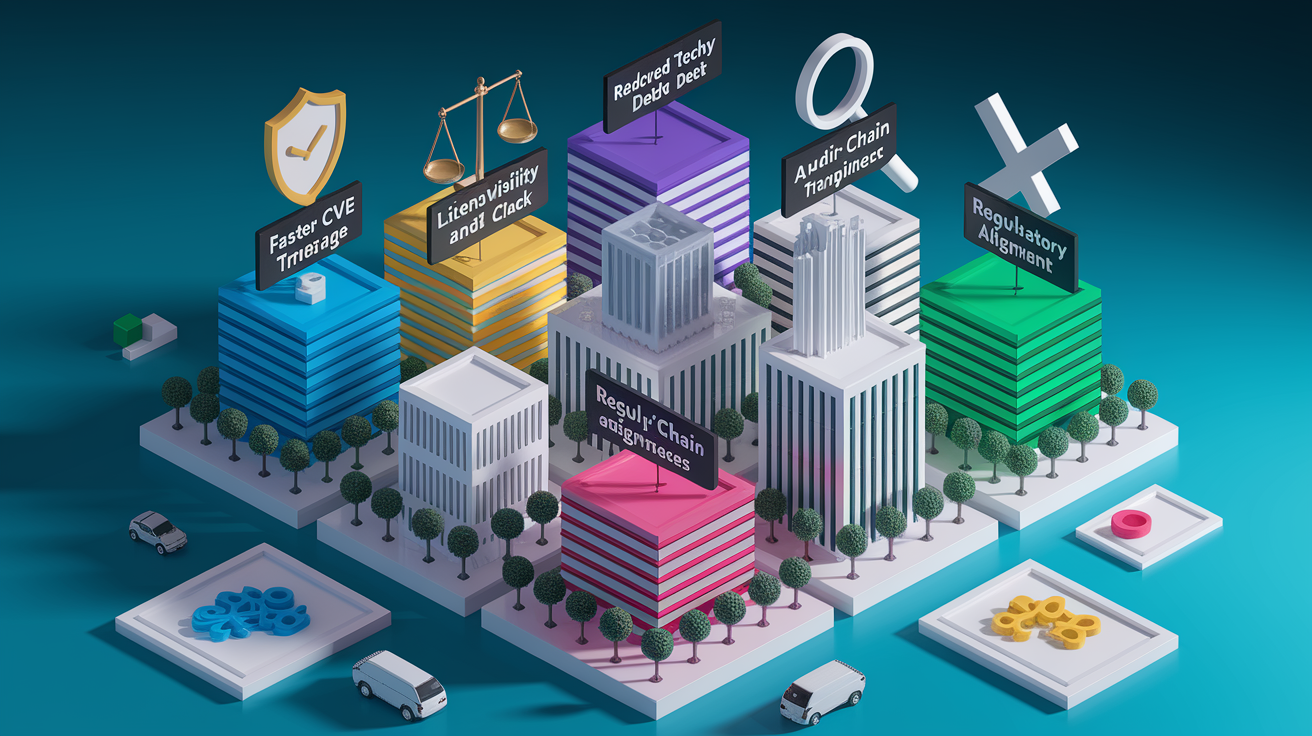
SBOMs collapse vulnerability identification from days to minutes. When a new CVE drops, security teams query the SBOM instead of manually inspecting every codebase, build artifact, and deployment. That speed is the difference between patching before exploitation and racing attackers who are already scanning for vulnerable versions.
License visibility keeps you out of legal trouble. If you unknowingly ship GPL-licensed code in a proprietary product, an audit or acquisition due diligence will surface that conflict. SBOMs flag those issues early, when you can still swap components or negotiate compliance. They also help legal teams prepare responses to open source license inquiries and demonstrate good-faith efforts to track obligations.
Operationally, SBOMs reduce rework and downtime. When a component is flagged as unmaintained or end-of-life, you know which apps depend on it and can prioritize migration. When a security patch is released, you know which environments need it. That precision cuts wasted effort and prevents outages caused by blind patching or missed deployments.
Key advantages:
- Faster CVE triage: cross-reference published vulnerabilities against your inventory in seconds, prioritize by exploitability and exposure.
- License compliance: document MIT, Apache, GPL variants and flag copyleft conflicts before they reach production or legal review.
- Reduced technical debt: surface outdated, abandoned, or duplicate dependencies so teams can consolidate and simplify.
- Audit readiness: produce compliance evidence for regulators, customers, or M&A due diligence on demand.
- Supply-chain transparency: trace component provenance and build metadata to verify origins and detect tampering.
- Regulatory alignment: meet federal procurement requirements, industry standards (NIST, FedRAMP), and emerging global mandates (EU CRA).
Regulatory and Compliance Requirements for SBOM Adoption

The U.S. Executive Order on Improving the Nation’s Cybersecurity, issued in May 2021, directed federal agencies to establish minimum SBOM standards and integrate them into software procurement. NTIA published those minimum elements in July 2021, defining what data fields, automation capabilities, and operational practices SBOMs must support. NIST followed with guidance mapping SBOM use to controls in SP 800-53, and FedRAMP incorporated SBOM requirements into its authorization framework.
CISA (Cybersecurity and Infrastructure Security Agency) formalized the timeline with secure software development attestation requirements. Providers selling software to critical infrastructure agencies must submit a completed attestation form within 90 days. All other government software suppliers have 180 days to comply. These attestations confirm that development practices include SBOM generation, vulnerability tracking, and supply-chain risk management. Missing the deadline can disqualify vendors from federal contracts.
Beyond U.S. federal mandates, the EU Cyber Resilience Act is pushing SBOM adoption across Europe. The regulation applies to connected devices and software products sold in EU markets, requiring manufacturers to document components, track vulnerabilities, and provide transparency to customers. As global supply chains intersect, SBOM practices that meet U.S. and EU requirements are becoming baseline expectations in procurement, vendor assessments, and partnership agreements.
| Requirement | Entity | Timeline |
|---|---|---|
| Secure software development attestation (critical infrastructure) | CISA | 90 days |
| Secure software development attestation (all other government software) | CISA | 180 days |
| SBOM inclusion in federal software procurement | U.S. Government (per Executive Order 2021) | Mandatory by 2025 |
| EU Cyber Resilience Act compliance | European Union | Phased enforcement starting 2024–2025 |
How to Generate and Maintain an SBOM Effectively

SBOMs should be generated continuously, not once at release. Every time you add a dependency, update a library version, or rebuild a container image, the SBOM needs to reflect that change. Treating SBOM generation as a one-time audit task defeats the purpose. Vulnerabilities and licensing issues emerge between releases, and an outdated inventory gives false confidence.
Software Composition Analysis (SCA) tools automate the heavy lifting. They scan source code, build outputs, container images, and package manifests to identify components, resolve dependency trees, and map licenses and vulnerabilities. Tools like Syft, the OSS Review Toolkit (ORT), and commercial SCA platforms can generate SPDX or CycloneDX SBOMs in seconds and integrate directly into CI/CD pipelines.
CI/CD integration is where SBOMs become operational. Hook SBOM generation into your build process so every commit, pull request, or container image build produces a fresh SBOM. Store those SBOMs alongside build artifacts, tag them with the same version or image digest, so you always know which SBOM describes which deployed instance. That linkage is critical during incident response. When a CVE is announced, you query the SBOM for the running image, not the one from last quarter.
To set up continuous SBOM generation:
- Choose an SBOM standard and format: pick SPDX or CycloneDX based on your tooling and compliance needs, support JSON or XML for machine parsing.
- Select an SCA or SBOM generation tool: evaluate Syft, ORT, or your existing SCA platform, verify it covers open source, commercial third-party, and custom components.
- Integrate into your build pipeline: add SBOM generation as a build step in CI/CD, trigger on every commit, pull request merge, or container image build.
- Link SBOMs to artifacts: store SBOMs in artifact registries or attach them as metadata to container images using image digests, version SBOMs in sync with software releases.
- Automate vulnerability cross-referencing: feed SBOMs into continuous scanning platforms that compare components against CVE databases and alert on new disclosures.
- Capture transitive dependencies: configure tools to resolve full dependency graphs, not just top-level packages, document when transitive tracking is incomplete and why.
- Version and publish SBOMs: treat each SBOM as a versioned document, publish the latest SBOM to customers, partners, or compliance teams via download links or APIs.
Supplier-provided SBOMs are helpful but not sufficient. If you rely entirely on what vendors send, you’re trusting their tooling, cadence, and completeness. Generate your own SBOMs internally so you control accuracy and update frequency. Treat supplier SBOMs as supplementary data. Cross-check them against your internal inventory and flag discrepancies. That redundancy catches gaps and builds confidence in your supply-chain visibility.
SBOM Use Cases Across Development, Security, and Compliance Teams

SBOMs serve different functions depending on who’s using them. Security teams query SBOMs during vulnerability triage and incident response. Development teams use them to track component freshness and avoid deprecated libraries. Compliance officers rely on SBOMs for audit preparation and regulatory attestations. Procurement teams request SBOMs from vendors to assess third-party risk before signing contracts.
Container security is a major use case. Cloud-native apps run hundreds of container images across clusters, and each image is built from base images, language runtimes, system libraries, and application dependencies. Generating one SBOM per unique image digest and linking it permanently to that image enables continuous vulnerability rescanning. New CVEs are published daily, so even if an image passed security checks last month, today’s scan might flag a newly disclosed flaw. SBOMs make that continuous evaluation possible.
Key team-specific applications:
- Vulnerability management and patch orchestration: identify which apps, services, or images contain a vulnerable component, prioritize remediation by exploitability and exposure, track patch status in SBOM metadata.
- Procurement and vendor evaluation: require suppliers to deliver SBOMs with software products, validate that third-party components meet security and license standards before integration.
- License compliance and IP risk: document all open source licenses (MIT, Apache, GPL), flag copyleft or restrictive licenses that conflict with product licensing models, prepare responses for legal reviews or M&A audits.
- DevSecOps automation: integrate SBOM data into CI/CD security gates, block builds that introduce high-severity CVEs or forbidden licenses, automate dependency updates based on SBOM analysis.
- Regulatory and audit readiness: produce SBOM evidence for CISA attestations, NIST controls, FedRAMP audits, or EU CRA compliance, demonstrate continuous tracking and vulnerability management processes.
SBOM Best Practices for Long-Term Lifecycle Management

Update your SBOM every time you update a component, release a new version, or discover an error in the inventory. Treating SBOMs as static documents breaks their value. If a component changes but the SBOM doesn’t, your vulnerability scans and compliance checks are wrong. Real-time or near-real-time updates keep the SBOM accurate and actionable.
Version your SBOMs like you version software. Each SBOM should include a creation timestamp, the tool or process that generated it, and a unique identifier or version number. Publish the latest SBOM clearly (on a product download page, in a container registry, or via an API endpoint) so customers and internal teams always know where to find the current inventory. When you fix an error or add missing metadata, increment the SBOM version and document what changed.
Best practices for SBOM lifecycle management:
- Update on every component change: regenerate and republish SBOMs when dependencies are added, removed, or upgraded, trigger updates automatically in CI/CD.
- Govern access and distribution: define who can view, modify, or share SBOMs, specify access terms for customers and partners, allow integration into their security tooling.
- Version and timestamp every SBOM: include creation date, generator tool, and a unique identifier, increment versions when metadata is corrected or enriched.
- Track provenance and build metadata: document where and how the software was built, include commit hashes, build environments, and signing keys to detect tampering.
- Flag known issues and risks in metadata: tag components with active CVEs, copyleft licenses, or end-of-life status, surface these warnings in SBOM queries and reports.
Final Words
You saw how an SBOM documents every component, the key fields to include, standard formats like SPDX and CycloneDX, regulatory drivers, generation tools, and lifecycle best practices.
Make SBOM generation part of CI/CD, version your outputs, and treat supplier SBOMs as complements, not replacements. A software bill of materials sbom gives the inventory and traceability you need to cut investigation time and stay compliant.
Start small, automate the pain points first, and you’ll reduce risk and ship with more confidence.
FAQ
Q: What does an SBOM software bill of materials list?
A: An SBOM lists all components in a codebase, including component names, versions, licenses, dependency relationships (including transitive), checksums/hashes, vendor information, and known vulnerabilities or patch status.
Q: What is SBOM software?
A: SBOM software generates and manages a software bill of materials by discovering components, recording metadata (identifiers, versions, licenses, hashes), tracking dependencies, and exporting machine-readable SBOMs for scanning and compliance.
Q: What is SBOM vs BOM?
A: SBOM versus a BOM: an SBOM is a machine-readable inventory of software components, versions, licenses, and dependencies; a BOM (manufacturing) lists physical parts, quantities, and assembly relationships.
Q: What is a software bill of materials SBOM on GitHub?
A: A software bill of materials SBOM on GitHub is an SBOM file generated or stored in a repo or CI run, typically using SPDX or CycloneDX, enabling automated scanning, supply-chain checks, and compliance workflows.